

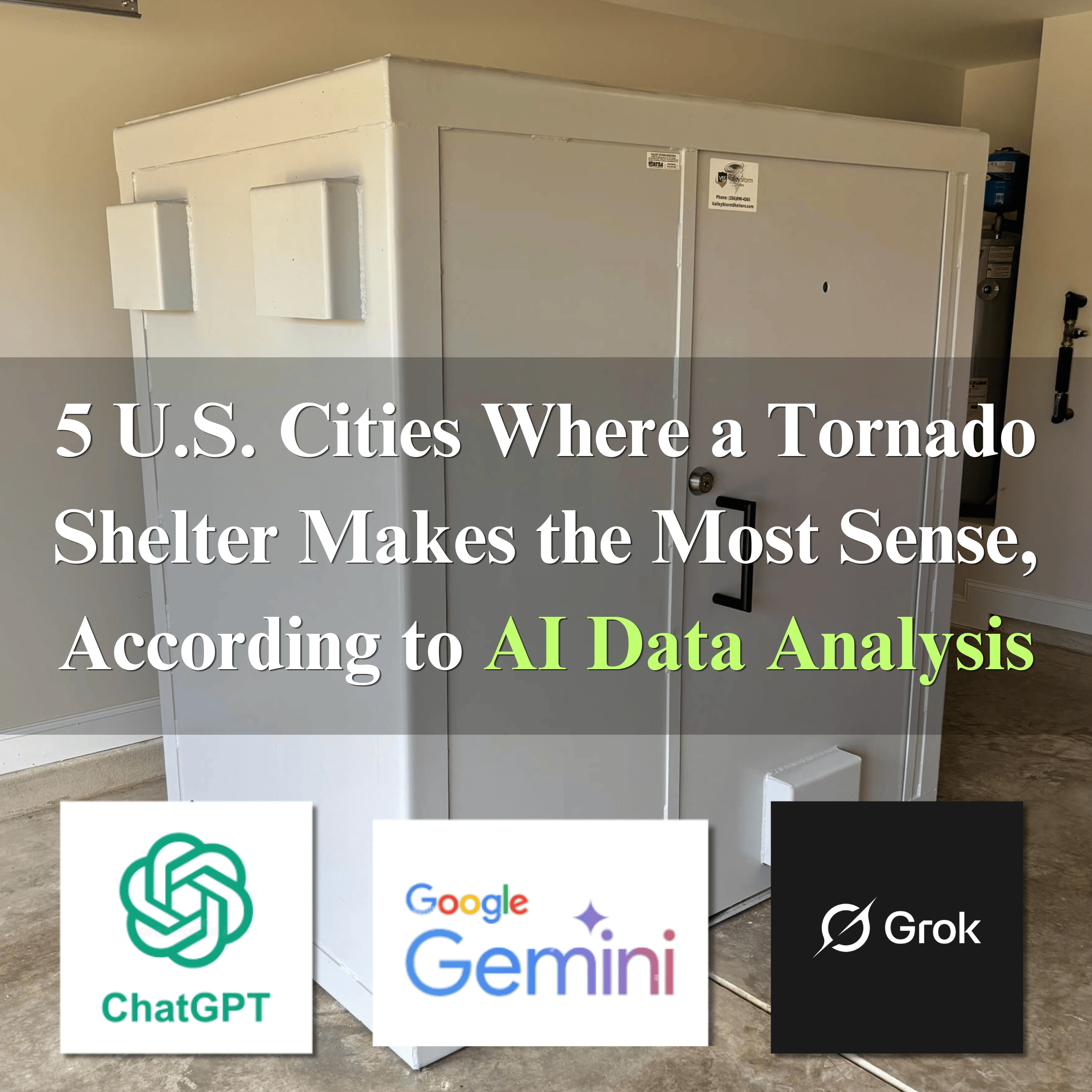
5 U.S. Cities Where a Tornado Shelter Makes the Most Sense, According to AI Data Analysis
By Valley Storm SheltersIn an effort to identify regions where tornado shelters are a critical investment, we leveraged three distinct AI services—ChatGPT, Grok, and Google Gemini—to analyze comprehensive tornado data. This analysis focused on a multifaceted set of criteria to provide a holistic view of tornado risk across the United States.
Methodology: AI-Driven Risk Assessment
Our AI models were tasked with evaluating U.S. cities based on the following key factors:
- Tornado Data**: Utilization of all available and most recent tornado data.
- Prevalence of Powerful Tornadoes**: Emphasis on EF2+ tornadoes, indicating significant destructive potential.
- Population Density**: Assessment of risk in densely populated areas, where impact can be more severe.
- Nocturnal and Terrain-Related Risk Factors**: Consideration of tornadoes occurring at night or in challenging terrains that reduce visibility and warning times.
- Lack of Basements or Underground Crawlspaces**: Identification of areas where traditional underground shelters are uncommon due to construction practices or geological conditions.
- Population Growth and Unfamiliarity with Local Risks**: Cities experiencing recent population influx, where new residents may be unaware of regional tornado threats.
- Long-Track, Rain-Wrapped, or Fast-Moving Tornadoes**: Factors that can significantly reduce warning lead time and effectiveness, increasing vulnerability.
AI Consensus: High-Risk Urban Centers
While each AI service offered unique perspectives, a clear consensus emerged regarding several high-risk areas. The analysis consistently highlighted the evolving nature of Tornado Alley, with a notable shift towards the Southeast, often referred to as “Dixie Alley.”
Detailed City Analysis
1. Moore / Oklahoma City, Oklahoma
Consistently identified by all three AI services, the Oklahoma City metropolitan area, particularly Moore, stands out as a paramount risk zone. Moore has a documented history of violent tornadoes, including the devastating EF5 events in 1999 and 2013. The region’s flat terrain and classic Tornado Alley setup contribute to an extremely high frequency of strong tornadoes. Despite a general awareness of tornado risk among residents, many homes are built on concrete slabs without basements, making dedicated safe rooms essential. Google’s analysis noted a trend towards above ground safe rooms in garages or closets to address this need.
2. Tuscaloosa / Birmingham, Alabama
This Alabama corridor was highlighted by ChatGPT, Grok, and Google Gemini as a critical area. Alabama consistently ranks among the most dangerous states for tornado fatalities. The region is characterized by violent, long-track tornadoes, hilly and forested terrain that reduces visibility, frequent nighttime events, and fast storm motion. The 2011 Tuscaloosa–Birmingham EF4 tornado serves as a stark reminder of the devastating urban impact. The lack of basements due to high water tables and increasing population density further amplify the risk, making home shelters a wise investment.
3. Jackson, Mississippi
Both ChatGPT and Grok identified Jackson, Mississippi, as a high-priority area within Dixie Alley. The primary concern here extends beyond frequency to the fatality profile, which includes overnight storms, heavy rain-wrapped tornadoes, lower visibility, and a prevalence of mobile homes in surrounding areas. Research indicates that the Southeast, including Mississippi, has some of the highest tornado casualty rates in the U.S., underscoring the importance of hardened shelters.
4. Murfreesboro / Nashville, Tennessee
ChatGPT specifically emphasized the Murfreesboro/Nashville area, noting that Middle Tennessee has become one of the most active parts of the evolving tornado corridor. Key factors include frequent severe spring outbreaks, significant nighttime tornado risk, fast-moving squall lines, and a high number of slab-foundation homes without basements. The 2020 Nashville/Mt. Juliet tornado outbreak highlighted the rapid and deadly nature of overnight tornadoes in the region.
5. Dallas-Fort Worth Metroplex, Texas
Google Gemini uniquely identified the Dallas-Fort Worth Metroplex. This area has experienced significant tornado activity, including EF-4 tornadoes impacting densely populated suburban neighborhoods, often at night. Rapid population growth has led to high population density and a prevalence of slab-on-grade homes without basements. A significant concern is that many new residents, unfamiliar with local risks, may underestimate the “DFW risk” until directly impacted.
Other Noteworthy Cities:
- Wichita, Kansas (ChatGPT)**: A classic Great Plains tornado country, characterized by open terrain, classic supercell formation zones, and repeated severe storm seasons. While visibility may be better than Dixie Alley, the potential for strong, long-track tornadoes remains extremely high.
- Huntsville, Alabama (Grok)**: This area consistently ranks high for cumulative tornado risk within a 75-mile radius, with frequent EF2+ and occasional violent tornadoes. Northern Alabama has seen major outbreaks and consistent spring/fall activity, often in wooded terrain that can obscure storms.
- Hattiesburg, Mississippi (Grok)**: Recorded a significant increase in high-intensity (EF2+) tornadoes, with direct hits from EF4 and EF3 events. Central/southern Mississippi is part of Dixie Alley’s core, where tornadoes, though less frequent than in the Plains, are often more deadly due to nighttime occurrence, rain-wrapping, and higher population/forest density.
- Memphis/Clarksville Area, Tennessee (Google Gemini)**: This region faces significant Dixie Alley risk, with a high occurrence of rapidly moving nighttime tornadoes. High water tables make basements rare and costly, leading many residents to consider safe rooms or community shelters.
- St. Louis Area, Missouri (Google Gemini)**: Missouri frequently ranks in the top 10 for tornado frequency. The St. Louis area, with its dense population and aging housing stock, faces challenges. Many homes lack basements, and suburban sprawl into high-risk rural areas compounds the threat. Studies indicate this area is highly vulnerable to “high-consequence” tornado events.
Key Considerations for Tornado Preparedness
The AI analyzes consistently highlighted several critical factors that underscore the importance of tornado shelters in these regions:
- **Slab-on-Grade Construction**: In much of the South (e.g., Alabama, Mississippi, Tennessee), basements are uncommon due to high water tables, expansive clay soils, and shallow frost lines. This leaves ground-floor interior rooms as the primary shelter option, which are often insufficient against powerful tornadoes.
- **”Dixie Alley” Shift**: Research indicates a significant shift in tornado activity from the traditional Plains Tornado Alley to the Southeast. Residents in these areas are often caught off guard by more frequent nocturnal tornadoes, which are particularly dangerous.
- **Population Density**: Increased population density means a higher likelihood of a tornado striking a residential area, leading to greater potential for casualties and damage.
AI Consensus on Top Cities for Tornado Shelters
| City / Metro Area | ChatGPT | Grok | Google Gemini |
|---|---|---|---|
| Birmingham, Alabama | Yes | Yes | Yes |
| Moore/Oklahoma City, OK | Yes | Yes | Yes |
| Jackson, Mississippi | Yes | Yes | |
| Murfreesboro/Nashville, TN | Yes | ||
| Wichita, Kansas | Yes | ||
| Huntsville, Alabama | Yes | ||
| Hattiesburg, Mississippi | Yes | ||
| Memphis/Clarksville, TN | Yes | ||
| Dallas-Fort Worth, TX | Yes | ||
| St. Louis, Missouri | Yes |
Conclusion
While the exact path of the next tornado remains unpredictable, AI-driven insights clearly indicate several high-risk regions where a storm shelter is a crucial investment. Cities such as Birmingham, Moore/Oklahoma City, and various areas across Tennessee and Mississippi consistently emerged due to their history of powerful tornadoes, significant nighttime storm risks, growing populations, and the widespread absence of basements. For families residing in these vulnerable areas, a tornado shelter transcends a mere home upgrade; it represents a vital investment in safety, peace of mind, and protection when every second counts.